
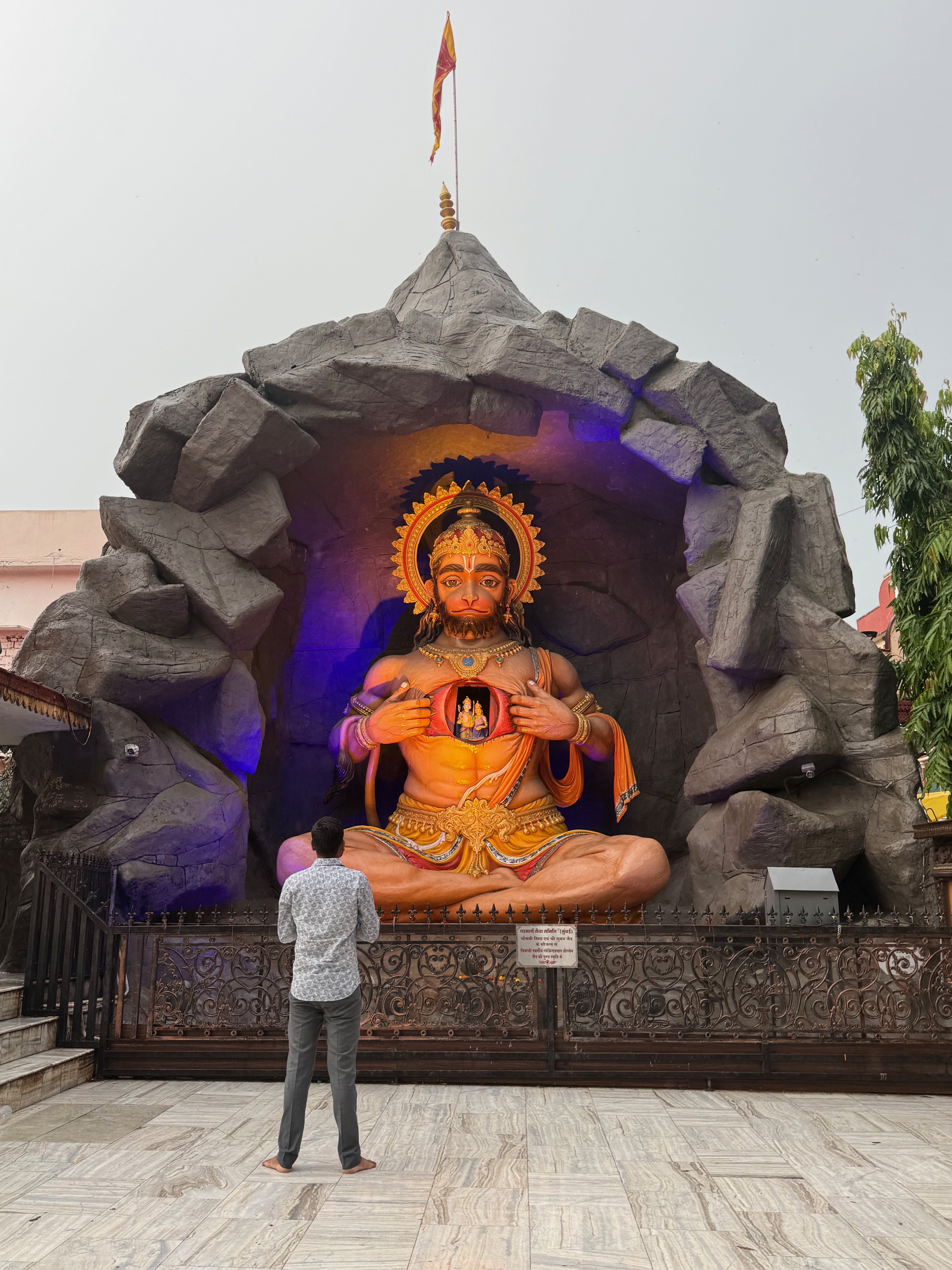
We headed north from Delhi toward the foothills of the Himalayas, looking for a less-crowded India with cooler weather and a chill attitude. Rishikesh, the self-declared center of yoga, meditation and spirituality, was the destination. Our goal was to do as close to nothing as possible: take in the scenery, do some yoga, relax.
A River With Somewhere to Be
Our hotel, The Glass House on the Ganges, sat high above the town of Rishikesh in a woodsy, rustic setting. The staff were all very kind and the food was amazing, but we found the real star of the resort out the backdoor of our room – the Ganges. The river flowed past as it has before us and will after. Although decidedly narrower this far upstream, the Ganges is an angry river with an impressive pace. Flooding, which had been in the news recently, was not an issue here where the Ganges was a half mile below us. We decided to get closer to it.
That first evening, a horn called us down a steep path to the Aarti, the ancient river ceremony that is omnipresent in Rishikesh. Shoes were ordered off at the beach. A saffron robed holy man supported by hotel staff in polo shirts was leading a small handful of guests in prayers to the river. They applied bindis to our foreheads which included grains of rice stuck in and put us to work. I was handed the lighted incense and was able to put my altar boy training to work swinging it out over the water. My wife Andrea was given flower petals to scatter on the current. It was almost serene but a chatterbox of a kid was running around the beach narrating his own head to the group and needed to be reunited with his iPad.
Some Ganges water found our toes which found the sand which found our shoes for the walk back up the hill.
Yoga, Deferred
The next morning at 7:20 our phone rang: ‘Your yoga instructor is waiting for you.’
‘Oh, we did not want him to wait. He should go ahead with the class.’
‘You are not coming?’
‘No. Is there no one else in the class?’
‘Not today, sir. He is here for you.’
I was there for my pillow. We promised to see him tomorrow at 7:00.
The next day, when we arrived, there were two mats for us and one for him. I introduced myself and Andrea. He said: ‘Sit on the mat.’ Without preamble he spat our yoga commands for an hour. I was soaked. We returned for yoga the next day and monkeys were leaping around outside the big glass windows, watching us sweat.
Monsoon Season
We set out to find the Beatles Ashram (officially Chaurasi Kutia) located on the East Bank of the Ganges. The band spent three months here in February 1968 studying transcendental meditation with Mahharishi Mahesh Yogi. There the band wrote a bunch of songs (most of the White Album and part of Abbey Road). They had a huge entourage which included dozens of press and other actors and musicians. Their stay ended amid scandal (not the Beatles doing). We arrived to find it closed because of the monsoon.
On the road back, hundreds of pilgrims dressed in saffron coloured clothing hiked toward a temple. The fervor was running high. There were also many monkeys along the route. Cows stood on the road as if they had been here first and had agency.
Rishikesh itself was a lovely town with small shops and laid back vendors. The town sees lots of European tourists and so we were nothing special. It was nice to be able to look at India without India looking back. We bought a lion’s head door knocker crafted in nearby Nepal. Yes, we found out, there are lions in India in the western desert.
The classic walk in Rishikesh is across the Laxman Bridge where there are no cars or scooters, just a teeming, fragrant mass of humanity. This was not what we were looking for but we did it. At one point I lost Andrea in the crowd. A pilgrim had grabbed her arm and applied a generous smear of red paint to her head, then asked for money. The pilgrim thought she was on firm religious ground and was closing in on a possible conversion. Andrea noticed the red paint had gotten all over her new, yellow dress and looked like she wanted to throw the pilgrim off the bridge. Just then the Monsoon rains came down.
At home we say ‘if it rains this hard, it can’t rain for long.’ That does not apply to the monsoon. We ducked into a café and climbed some steep stairs. This was a no shoes place. There were low tables scattered about with daybeds and pillows on the floor. We headed for a window table with actual chairs to watch the rain. For what seemed like an hour nobody came to ask what we wanted. The whole place appeared pleasantly stoned. When the food and tea came, we were really happy and waited out the rain in the blissed out café.
The Superbowl of Aarti
The Aarti at our hotel had been somewhat subdued so we set out to find the real thing downtown. And that was a great idea.
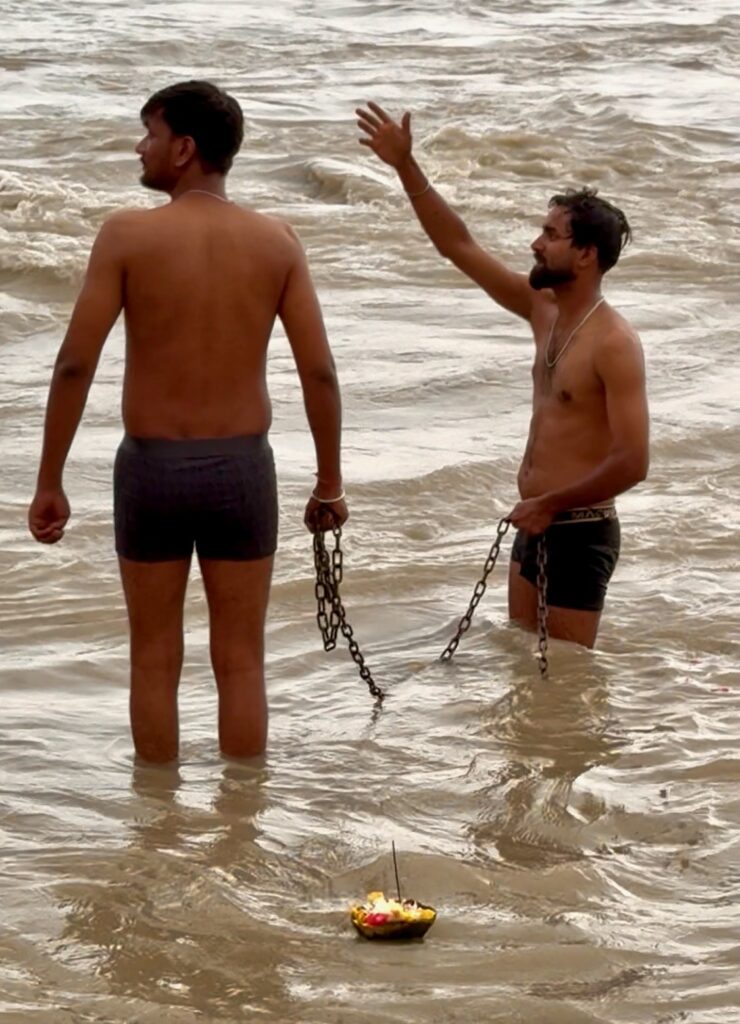
People waded into the Ganges, overjoyed, pouring the water over their heads and splashing their faces, some fully clothed, some kids completely naked. Young men swung out into the impressive current on chains and ropes tied to cement posts. Cows wandered through. One ate lustily from a garbage can: another made eyes at a corn roaster, hoping for a charred ear. The music was pulsating. Incense filled the air. There were huge statues of the gods – which gave Disney vibes for scale, colour and facial expression. It was wonderfully overdone. There were bleacher-style stands on the river, long queues to get in, lots of pushing and positioning, and video screens for those who could not get a seat. Offerings in the form of banana leaf boats filled with fire, flowers and rice were sent down river by the hundreds. Some were more sea-worthy than others. Nothing subtle was happening here. The fervor was genuine and rising.
An Aarti of our Own
Confident we now understood the idea of the Aarti, on our last night, we tried to participate rather than simply observe. At a smaller ceremony down the Ganges, we made our own offering to Andrea’s father who would have loved the idea. Many people in India scatter the ashes of their loved ones in the river. The Ganges is the soul of India but it is also its graveyard.
The monsoon returned and we ducked inside a kind of open shed (like a run-in barn) facing the river. Seconds later a group of cows came running and piled in with us. When the monsoon abated, we listened for a while to the music with clay pots serving as percussion. It was wonderful. The sky cleared and we could see the Himalayan foothills poking in and out of clouds and later, a sky full of stars.

Bill McCarren lived in Delhi during the most recent monsoon season. When he is not there or somewhere else, he is in suburban Washington, D.C. with his wife Andrea and two Labrador Retrievers.

