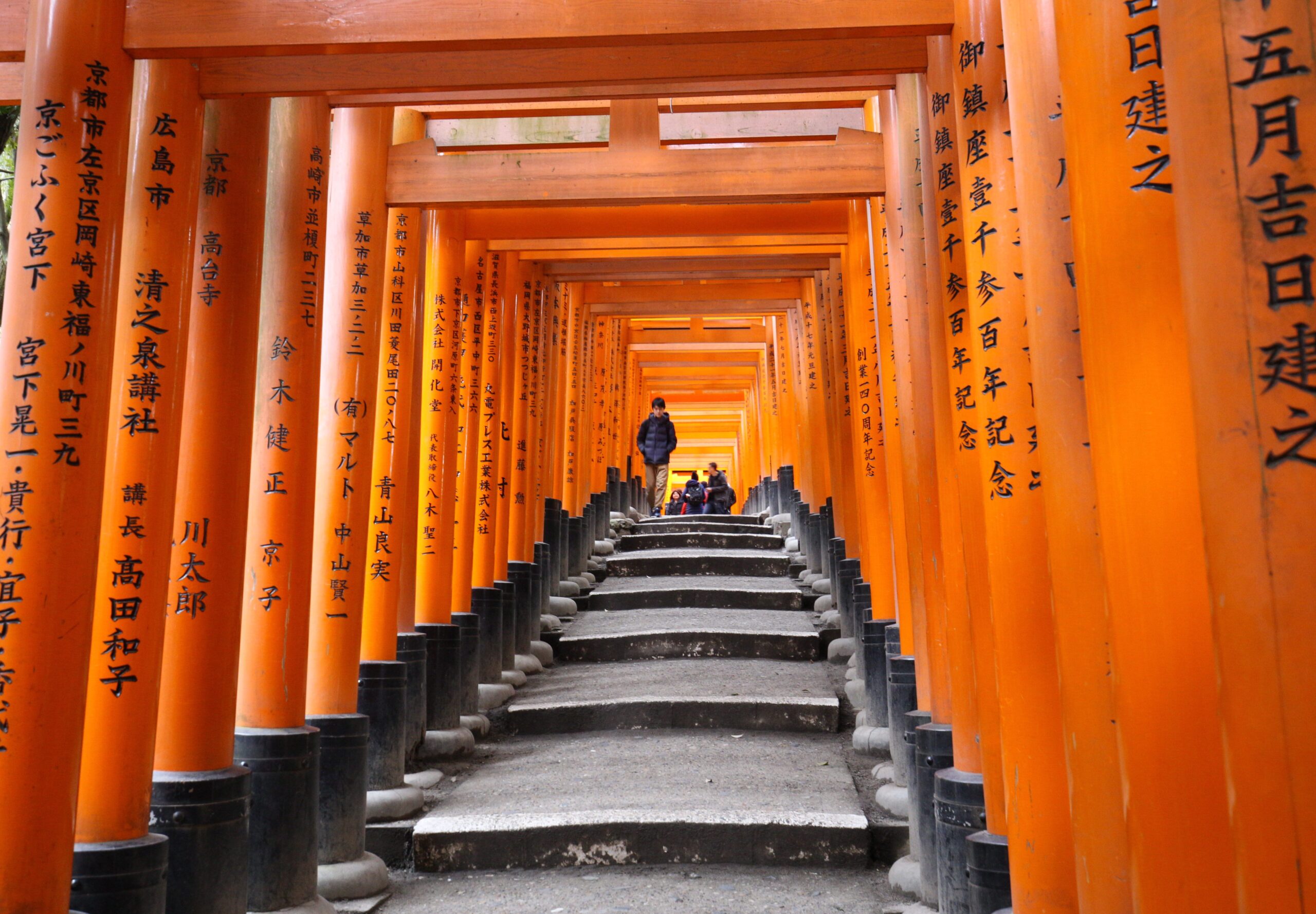
In Japan, torii are traditional gates shaped a bit like a character from the Japanese alphabet, with two vertical pillars intersected at the top by two horizontal beams that stick out slightly on either side, the way the horns on a samurai’s helmet might. They are used to mark the entrance to shrines that beseech you to pay attention, like a pylon you might find next to an open manhole. Each one symbolises a transition from the trivialities of the world we know towards something more sacred.
Since learning this, I like to think of the metal detectors at airport security as ‘airport torii’. Only when I have passed their test do I feel like my journey has truly begun. Any expectation of home or familiarity has been left on the Arrivals side with the check-in counters and taxi queues. On the Departures side, I enter a state of receptiveness, novelty, inspiration, and epiphany.
On every trip I’ve ever taken, this has allowed me to discover some new faith, whether in the divine qualities of Danish cheese and Belgian beer, the restorative properties of Turkish hammam or Buddhist meditation, or conviction in the infinite strength of elderly Portuguese women and the genuine kindness of Japanese strangers.
So, as one undertakes the famed trek at Fushimi inari-taisha, one will pass through nearly 10,000 torii placed one against the other like a line of dominoes that disappears up the hilly terrain. Logically speaking, this suggests a visitor who completes the whole path will complete nearly 10,000 spiritual transitions along the way.
At numerous points along the winding mountain trail, forks in the road appear, offering different choices of torii-covered routes. Along whichever you choose, side paths are revealed, leading to smaller shrines where one must pass through ever more torii. And it’s common then to find amongst the boulders and cedar trees lined with moss, stone shrines adorned with miniature versions of the same torii that mark the path that has led you there.
Many of these are sized as if to accommodate the souls of the tiny Buddha statues, no bigger than a garden gnome, that you’ll sometimes see in the area of shrines, and would be impossible for a mortal human to pass through. But whether functional, or merely symbolic, the repeated appearance of torii leaves one with the impression that the traveller is meant to come away with a single encompassing message from their experience – that the opportunities for revelation along life’s journey are endless.
Stopping at one of the lookouts to take in the breathtaking views of Kyoto stretched out below, I meditate on this notion, thinking ahead to some future journey not yet determined, spurring events leading to personal discoveries yet uncovered. The whole world seems to vibrate with potential and – aware of the hair on my arms beginning to stand – I breathe it in, confident that every time I pass the invisible barrier of airport torii, I will once again enter that state of boundless reception allowing me to experience it all.
Gango-ji
They say it was a fortuitous dream of paradise
That woke the priest that day
Where no faithful came with the crowds of cherry blossoms
Brightening and bending the boughs of the trees
And the smell of incense was weak on the wind
Where the lone offering he’d left the night before
Still smouldered in its bowl of stale ashes.
No bells rang out in the silence of spring
And the only souls who still believed were the ones
Turning in their graves beyond the temples’ easterly corner.
They say it was here where the rituals of life had lost meaning
That the idle priest suddenly resolved to take up his brush,
Following its frivolous wanderings,
Painting madly as if gripped by some terrible fever.
Each stroke seemingly involuntary,
It wasn’t until the brush finally dipped from his spent fingertips
That he recognised the great mandala that stood before him
Depicting a Buddhist paradise he’d known
Only fleetingly in the deepest hours of sleep.
Yet now, manifest before his naked eyes
He knew it like an old friend who’d reappeared without warning.
Adrenaline flowed through his old veins
For what felt like the first time in ages as he spoke to the boy out sweeping the path:
‘Come,’ he said,
Ushering the youngster towards his project.
After that the news spread quickly,
And before he knew it,
Many of the once devoted disciples he’d believed forever gone away
Were returning to marvel at what he’d done.
Then the courtyard was full of soft chatter again,
And the leaves were swept not only by the children
But by the long sleeves of the faithful’s robes.
And the priest,
Upon smelling the air and noting the prevalence of incense,
Smiled to himself now and knew –
This was paradise.
*
On the steps of Gango-ji
Someone asks what brought me to Japan.
Places You Can’t Take Pictures
My favourite places have always been
The ones you can’t take pictures of,
Whose details are committed to
The imperfect pastures of memory,
But whose sensations can be retrieved
Whenever conditions are just right.
Like the way I think about Cuba
Every time I smell tropical ocean air,
Reminding me of how that same smell
Invaded the cabin before we’d even left the airplane.
Or the way a sunrise four years later
Suddenly calls to mind the time we witnessed
Times Square come to life
After arriving at 4 a.m. by bus –
A prickly feeling,
Like blood rushing back into a giant.
Now, on the streets of Tokyo,
Where Godzilla peaks out between skyscrapers
And murderous blowfish circle their scummy tanks,
I contemplate the future under a paper lantern
And wonder what event will trigger this feeling
Of complete alienness again.

Matt Fournier is an author of poetry, short fiction, and children’s literature. Residing in Yellowknife, Northwest Territories in Canada’s remote subarctic, travel has long been more than just a hobby to him, but a necessity. In 2013, Matt completed a Bachelor of Arts in Creative Writing at Concordia University in Montreal and since then has published two children’s books including The Outlaw Amy Joan (2022) and Abby Zoo Turns into a Mosquito (2024). His poetry and fiction have appeared in publications such as Buttontapper Press, Lunch Ticket Magazine, Halcyon Magazine, Poetry Breakfast, and Hash Journal.
Cover photo credit: David Redfearn