I.
For my fortieth birthday, my sister gave me flight. I flew from my home in Australia to hers in Germany, then we travelled – with my brother and her partner and their daughter – to Greece.
She also gave me a luggage allowance that far surpassed my needs: despite my best efforts, I had nearly 15 kilograms to spare when coming home.
Most of the souvenirs I returned with were edible: never-before-seen lollies and chocolates for my husband and our kids, two litres of farm-fresh olive oil for entertaining friends, but the most unique souvenir I acquired weighed nothing: This is because the most unique souvenir I acquired was a tattoo.
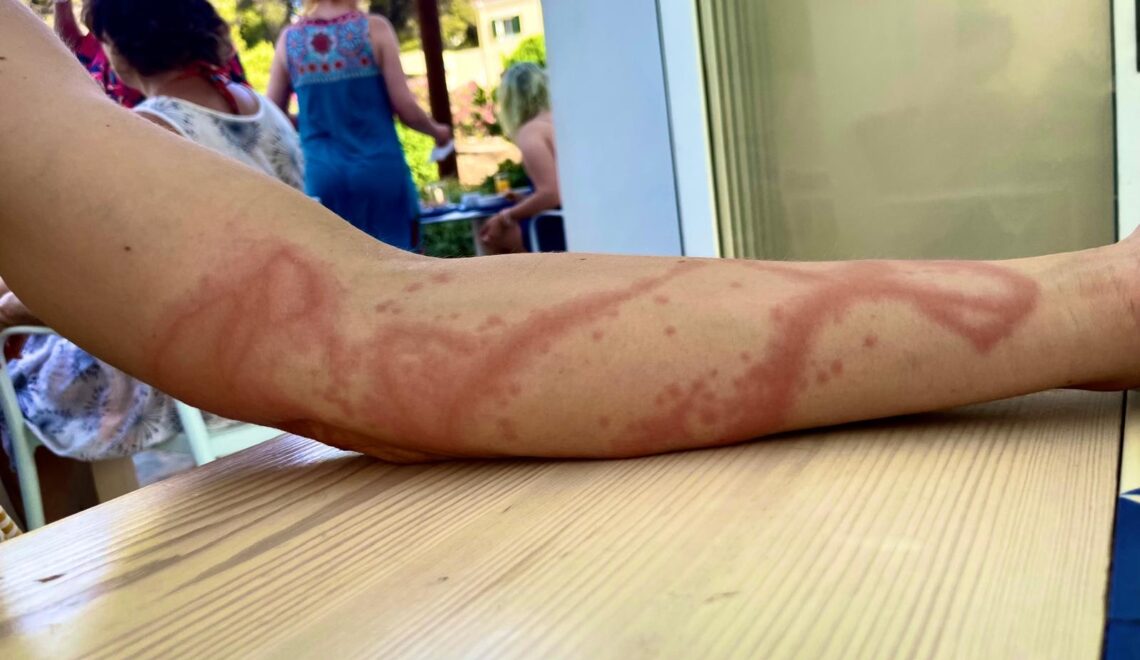
I’ve never wanted a tattoo, and I didn’t ask for this one. It happened against my will while on a Greek island. What’s more, it wasn’t a carefully chosen, carefully inked design; it was more akin to the random scratches compass points can make on desks. And it wasn’t subtle, or even small: its jagged lines ran from my wrist to my elbow.
It could have been worse. It was on my arm, not my face. It didn’t get infected, and while it was painful enough to make me shriek initially, and stop me from sleeping later, after a few days it looked worse than it felt. Also, it was free of charge. Even so, I hope I never meet the ‘tattoo artist’ again. There’s little risk I will, because the tattoo artist was a jellyfish. Or at least, I assume so; I didn’t stick around to find out.
My brother and I were swimming round rocks, gazing at fish, when the sensation of a bee sting on one arm – or rather, scores of simultaneous stings all over it – made me shriek that I’d been stung and make for shore. He followed, albeit at a more leisurely pace.
By the time I emerged from the water it looked, and felt, like I’d been burned. Later, the scrawls that ran along my arm would grow angrier and redder, and splotches and spots would appear. Later, I would ask a chemist whether it would ‘sort itself out,’ only to be told, ‘Not so simple! This is a problem we must solve!’ Later, the burning feeling would be replaced by intense itchiness that would make sleep impossible.
But, once the panic and the pain and the itching subsided, I would not be averse to the fact the scar might not disappear, or might fade then reappear, and would not hesitate to tell the story or show my friends my ‘sleeve’.
II.
My stopover at a Middle Eastern airport on the way home also yielded an unintended memento: a conversation I later relayed (okay, okay, performed) to my husband and our eldest son. It took place after I’d parted with my siblings, and it took the form of (many) group messages.
First, I told them my 8 p.m. flight had been delayed amid rumours the plane was too hot to fly. I wondered how an overheated plane could be expected to cool in 100 degree heat with 80% humidity – and how the world could be expected to stop warming with planes, and people like me, still heating it. I also sent intermittent descriptions of the scene: we’d gone through a second security screening, which meant we had no water and could no longer access a toilet, let alone shops. The staff didn’t seem to know what was going on, and people were getting thirsty and hungry, fearful and furious. I joked that I was only concerned about my baggage: Was my stash of chocolates and lollies melting? Was my premium olive oil becoming less premium by the minute?
We’d been finding ChatGPT’s serious responses to strings of increasingly silly questions a reliable source of humour, if not intelligence, so my brother consulted it on my behalf. To cut a long, dot-pointed answer short, it seemed ‘prolonged’ exposure to temperatures above 21°C could indeed harm my liquid gold. As for why my plane might be too hot to fly, apparently heat could impair its lift and thrust, especially with a heavy payload. (A preferred – human – source later added that perhaps the brakes, post-landing, couldn’t cool until the weather did.)
At that point my sister shared a CNN article about another flight thwarted by heat; I claimed I was more concerned about my olive oil ‘payload’ than the plane; and my brother asked ChatGPT how conditions like those described by CNN would impact his sister’s precious oil. They say adults ‘regress’ when with their siblings; the fact I was travelling without my own children, responsible only for myself, made me even more childish. The mood in the passenger lounge was far from jovial, but the fact laughter would be inappropriate only made mine harder to contain.
That was before I mentioned I’d befriended a fellow passenger called Tony, before my sister’s partner chipped in with a picture of Tony Soprano, and before ChatGPT said it would have ‘definitely chuckled’ if sentient. It was before Passenger Tony told me he worked in ‘logistics’; before my sister said we all knew what that meant; before ChatGPT drew parallels between Tony Soprano’s expression, my flight’s delay, and the all-important oil; and before Passenger Tony asked me what was so funny. It was after we’d finally been given water, and before we were herded to a food court for an almost-midnight feast. It was after we were given more water, then forced to throw it out, because all of a sudden we had to go back through security, board the plane, and wait some more.
At 1 a.m., the happy ending: we lifted off.
Later, I thought about how the most undesirable travel experiences often make the best stories – provided you escape unscathed, or only slightly maimed. Yes, travelling with my siblings as adults was thrilling for me, but it doesn’t readily translate into a thrilling tale. And while swimming on beautiful beaches and feasting on fresh island produce day after day was the stuff of dreams, when you’re enduring work and winter, do you really want to know?
What those who stayed home do want to hear about, is stories about being maimed by venomous creatures, and trapped in foreign airports, stories about the pain, discomfort and unpredictability of travel, and the relief of getting home. Stories that, far from inducing envy, can make a person feel content.
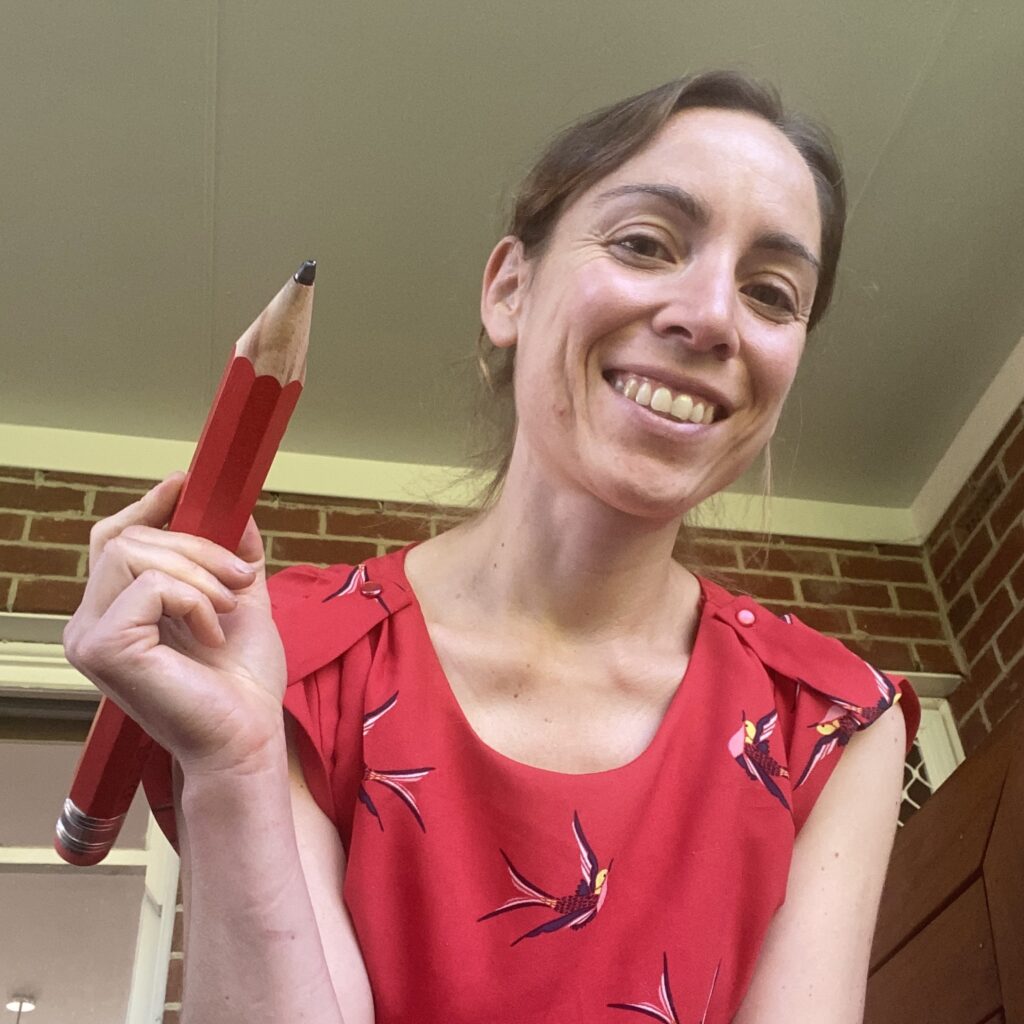
Emma Wilkins is a Tasmanian journalist and freelance writer who’s been published by magazines, journals and news outlets in Australia and beyond. You can read more about her on her official website.